Sunday, August 25, 2013

Week 34: Butter

   The book-of-the-week for week 34 is titled Butter. It was made to go with the pottery butter dish shown below. The butter dish was made from low fired red earthenware clay, then painted with colored underglazes, and finally fired with a clear glaze. It's about 5 inches in diameter and about 4 inches tall.

scenes of an ancient asian landscape are painted on the outside...
Lift the lid and inside is the little book Butter. Shaped like a block of butter, the marbled paper pages covering 2-inch squares of book board are meant to resemble sliced pats of butter.  The text was printed on the letterpress with Ionic typeface in 14-point font.... and its all about the butter!  Chapter 1 of the book is titled, Butter Rhyme...


Butter Rhyme

Butter on biscuits
Butter on toast
Butter on hot rolls
I love the most!

a sonet to butter leads to Chapter 2. Butter Facts 
     Wikipedia states that butter is made by churning fresh or fermented milk (or cream) from cows, sheep, goats, buffalo, or yaks. Preservatives, salt, and flavorings can be added to butters too. Honey butter, herb butters and salted butter are most common... When butter is rendered the butter is clarified... which is almost 100% butter fat. This is called ghee... common in India's cuisine...and probably why India is number one in butter consumption...  But butter is popular all over! There have even been movies made about butter.  In 2011 the movie Butter (no relation to this book Butter) was released starring Hugh Jackman and Jennifer Gardner. I rented it on Netflicks...It's funny! So check it out at http://movies.netflix.com.

   After the opening sonnet, there are two chapters on Butter Facts and More Butter Facts. Most likely, there should be a couple more chapters on Butter Facts. The history of butter goes way back.. Butter (as ghee) has been a symbol of purity and an offering to the gods of early Hindu cultures for over 3000 years. In Scandinavian countries during the Middle Ages butter was made for commerce. In warmer European climates it was a common food source but had a low reputation. In Ireland it was put in kegs and buried in Irish peat bogs for years. (It's still being dug up!) It was even used as lamp oil. Slowly, butter became accepted by the upper classes, especially since the Catholic Church said it was ok to eat it during lent. By the 18th century the French had developed a world-class cuisine with butter as one of the main staples... along with wine... ahhhh. Really, who can argue that a french croissant isn't one of the greatest foods EVER? It wins every argument just by being so delicious and unexplainably flakey.

Chapter 4. Butter Words
Butter has worked its way into our palate and our culture in many ways. Chapter 4 lists a number of words with butter as the root...  just saying butter is fun. Which is probably why there is an English tongue twister about butter and a lady named Betty Botta...

Chapter 5. Betty Botta's Better Batter
Betty Botta's Better Batter

Betty Botta bought some butter;
"But," said she, "this butter's bitter!

If I put it in my batter
It will make my batter bitter.

But a bit of better butter
Will but make my batter better."

Then she bought a bit of butter
Better than the bitter butter,
Made her bitter batter better.

So ´twas better Betty Botta
bought a bit of better butter.


And the last chapter is a simple butter haiku...


   Who doesn't remember pulling a buttercup stem from a tuft growing in your backyard and holding it under your best friend's chin to determine if she liked butter. It was a little girl's version of a magic trick. ...and much easier then juggling.


Though there are many health reasons to limit butter in your diet... without it life wouldn't be quite so delicious!

Sunday, August 18, 2013

Week 33: Pennies in the Well

   The book for week 33 is Pennies in the Well. This little book, 2 ¾ inches by
4 ¼ inches, is a collaboration from a variety of artists, family members, and friends about something we all do... wish.

Punched copper letters and pennies...

The cover is two pieces of 16-gauge copper and pennies. The copper cover pieces have been glued onto the text block with E-6000 seriously sticky glue. Each page of Stonehenge paper was letterpress printed with the words I Wish... 

Japanese paper and letterpress text
   The printing was done on the Pearl letterpress. 24-point BRUSH typeface and 24-point Goudy typeface were used for the printing. As usual, Pearl was sweet as pie and the printing went without a hitch! 


Pearl the Press
  The wishes were filled in (on the back of each page) by all of the collaborators. I love the individual handwriting. No direction or theme was given for the wishes... everyone could wish for anything they desired. Surprisingly, sometimes it took a little while to decide what to wish. Payment was a chocolate mint patty... when you're asking a favor like this, it helps to have a gift or a payment to say thanks. :-)

handwritten wishes...
Many wishes were illustrated in some way. Dreamers are often imagining what it looks like when their wishes come true... artists like to draw it.

illustrated wishes...
When the book was finished, it fanned out in a pretty array... as do the pennies in the bottom of a wishing well. This is the story, Pennies in the Well.

looking in... a cluster of wishes

I wish...     That time travel was possible
                  That I could go to England
                  That life made more sense

I wish...     TRUE OPEN MINDS
                   FROM ALL

I wish...     that everyone could have peace
                  in the world!

I wish...     I WISH FOR THE FAIRY TALE 
              ENDING THAT SHE 
              PROMISED ME

I wish...     I wish my brilliant brother
                  would find a job he loves
                   in Raleigh

I wish...     I wish my sister Kitty
                  could live pain free 
                             . . . . .

I wish...     there were no 
                  unwanted pets
                          
I wish...     those I love (and
                  me) stay healthy

I wish...     to make something
                  beautiful every
                  day

I wish...     Sasparilla Moonbeams

I wish...     I were a butterfly and
                  could see the world
                  on the wing and a
                  flower.

I wish...     PATIENCE

I wish...     that my aunt fully recovers
              from breast cancer
              and that my mother-in-law
              fully recovers from her 
              stroke

I wish...     to retire early
       & healthy.

I wish...     I wish I could
             spend one month
             making pottery!

I wish...      That all of the people
                   and animals in the world
                   were safe.

I wish...     I build more friends,
                  lessen my enemies,
                  reduce my stress,
                  enjoy the blessings,
                  appreciate HIS presence
                  every moment everyday.

I wish...     I wish to be camping
       under the stars tonight.
              ★    ★
         ★      ☽     ★
             ★     ★

I wish...     to find the joy in
                  the little things

I wish...     to hold onto the
                 happiness of memories
                 not the pain of loss...

I wish...     for always love,  for
                 support & strength, to
                 give and receive, and
                 always love. ♡

I wish...     adults would act
                 like children more often
                 and remember what it is
                 to be free

I wish...     I could go back in time so I
                  could have been present at the
                  time monks were making illuminated
                  manuscripts - it would be wonderful
                  to be able to watch them work. OR I
                  wish I could work at the British museum
                  w/ the illuminated manuscripts.

I wish...      "for world peace...
                   and a Winnebago..."
                   (-the movie Sneakers)

                  The End

What would you wish for?

Sunday, August 11, 2013

Week 32: Laundry Poem


   Mysterious and surprising...moving and static.. poetic and plebian...all those adjectives apply to this week's book-of-the-week, Laundry Poem. Created as an example book for an upcoming class, this stiff leaf book is a drop side box with a poem written on the inside walls.

Marbled paper, Japanese paper, and bookcloth on the cover


When the top is removed, all four sides fall to the table...

Looking down... what's inside?

and inside is the poem, Laundry Poem, written by Rachel Steinsberger, and the surprise.

Peeking in... anticipation as the walls fall down


all bound up, tied up, connected, made one...

sides laying flat, the laundry stands in the middle...

 This is the what's written inside...

Laundry Poem

lifting the lid of the washer
coin operated
in the basement
sunlight fighting against 
the dirty window
A feeling passed over me

clothing twisted together
a blue sweater arm embracing
a bleeding denim leg. 
the light load
woven with things that 
shouldn’t even be there

nylons, bras, yesterday’s change. 
Everything
worn monday past two
maybe three sundays is now
a large mass of oneness


like Pandora's box, anything could be inside!
   Books are like that... anything can be inside... and the different ways information...communication is expressed is all wrapped up in the term book. Within the covers of a book can be any sort of information... any sort of imagery. ....A novel, a textbook, a bible, a book of poetry, a photograph album, a list of assets, debits and receipts... or just blank space...  And the shapes of books aren't always the standard rectangular tome with a spine and flipping pages. Books can be scrolls, can be single leaves stacked and stored within a special box or envelope...some can be flipped and twisted, or folded out into a series of zigzag pages or waving leaves... yet still be a book. The definition of a book is nebulous. This little book doesn't look like a typical book.. so, is it still a book? What constitutes a book? ...a spine:? a cover? ...pages that turn? ...a plot?  a story? ..a theme? all those things? or only some? I think it's all wrapped up together, somehow, one part bleeding onto the other... just a... book.

Sunday, August 4, 2013

Week 31: Stepping Stones

   There's a saying that always makes me laugh... "You can't get there from here." Yet, in reality... though a route is convoluted, the place we're trying to get to can be reached... just maybe not as easily as expected...and maybe it's not the place we imagined... (but that's another story.) This week's book-of-the-week is about the Stepping Stones we take in life.

Cover of marbled paper and letterpress printing
   Stone-like marbled papers on squarish mat board make up the pages, which are connected with strips of pastepainted Tyvek®. Bound as an accordion book, the pages fold out in a zigzag or a straight line... either way is ok. The story was printed on the Pearl® letterpress with Brush type.. It's a story that can be added to by the reader... so fill in your own stepping stones. The basic story goes like this...

"STEP     STEP    STEP    STEP    STEP    STEP    STEP    STEP  

Stepping stones through the tall grass..

“JUMP!”

Whether it's across a tiny stream or into the the great unknown...
Sometimes you just have to go for it!

Sunday, July 28, 2013

Week 30: The Alphabet of Obscure Words

   Every writer is in love with words. The English language is truly complex. With words from so many different countries and cultures over the ages, it is a sociology and a history lesson as much as an exercise in grammar and pronunciation. To that rich history add a lot conflicting rules and unexplainable confusion, and the English language becomes a sort of linguistic puzzle for the neophyte. This week's book-of-the-week, The Alphabet of Obscure Words, is a tribute to words.


   The pages of this book are recycled pages of a childrens' book titled How Things Work. Each page is gate-folded on the fore-edge corners to form a sort of arrow shape. The side opposite the point is bound to form the spine edge. Then, the whole thing is case bound in the recycled cover boards of the childrens' book. 

Red book cloth on the spine and a cute calico headband...
A pocket is formed on each page where the gate-folds meet. Inside each pocket is a removable card with the alphabet letter and it's obscure words..  The words were found in a 1946 edition of The Webster's Dictionary, then typed onto the alphabet card with an 1978 Olivetti Electric Typewriter.
E is for...
Remove the card to read the words... and use a dictionary if you want to find out what they mean!

L is for...
   Some words have long histories dating back to ancient customs and obscure meanings. Others are formed from the inventions and discoveries of modern times... For wordsmiths, the meanings of words have the same effect as traveling to distant countries and seeing new and unknown sights. .. and it's much cheaper!

Painted bookcloth spine
Only one page of obscure alphabet words has been included in this blog... but don't worry! If you want to know more obscure words, just read any dictionary... and write your own Alphabet of Obscure Words.

Sunday, July 21, 2013

Week 29: Making Pottery in Pittsburgh


   Sometimes there is poetry in a space... as Gaston Bachelard said, “The poetic image […] is not an echo of the past. On the contrary: through the brilliance of any image, the distant past resounds with echoes.” And the book-of-the-week for this week, Making Pottery in Pittsburgh, reinforces that idea.. a connect of objects crafted and something as big as the poetics of a time and place.
Handprinted spine piece and pastepaper cover...
The book is an assembly of photographs of handmade pottery, paste paper, collograph prints, marbled paper, handmade paper, and a story of a period in time...

The title page and a map of the Shadyside neighborhood in Pittsburgh, PA
Under the title strip A marks the spot....5815 Holden Street, Pittsburgh, PA
                                Making Pottery in Pittsburgh

   I was at Penland in the summer of 2001, working on the Annual Benefit Auction, when I heard Bea had been accepted into the high school program at the Pittsburgh Ballet Theatre. It was one of the top ballet companies in the country and she had worked so hard for many years to get this opportunity. There was no doubt that we would embrace this adventure. I had one week to go online and scope out apartments and neighborhoods in Pittsburgh... because in four weeks she and I would both be moving to Pittsburgh for two years. So I packed my favorite things, my Grandmother’s bedroom suite, some favorite books, my potter’s wheel, my kiln,and my darling daughter to start our sabbatical in Pittsburgh.


Page 1: "I packed my favorite things..."
   That fall was golden. Our turn-of-the century neighborhood of rambling Victorians was so quaint and beautiful. The craftsmanship of the stained-glass windows, wrought-iron railings, carved stone and woodwork embellishments,and slate roof tiles with copper flashing began to fill my imagination. I was transported to the past and dreamed of Pittsburgh in it’s heyday when it was one of the wealthiest cities in the world, 150-year old gnarled oaks, maples, and ginko’s...with leaves of chartreuse, yellow, red, and orange lined the cobbled sidewalks where I tripped and stumbled - eyes on the stately homes rather than watching where I was going. I began to paint it all on my pots... railings and dragonflies,lattice-work and rivets.


Dragonflies, lattice-work and rivets...
   We settled into our little carriage house-behind-a-house on Holden Street in Shadyside. Bea started 11th grade at Schenley High School and I set up my pottery studio in the tiny one-window basement and begun throwing pots. We both worked hard,,, to get ahead in our art, to make friends, and to discover the city of Pittsburgh. Bea bonded with her ballet friends, a small band of boys and girls from all over the country who came to study ballet while attending high school. They had their own sort of clubhouse within the inner-city school...in the book-lined homey office of Mr.“G”, the school's English and Drama teacher... and their own father figure. Lunches, breaks, and study-halls were spent sprawled across the leather couches or hunched around his broad antique oak table, as she settled in to the routine of dance, school, and Pittsburgh.
    Three weeks after we moved in I dropped Bea off at the ballet school for early practice, then ate my breakfast while watching VCR tapes of her old recitals. When the tape ended and the TV switched to the local station, instead of Good Morning America I saw half an airplane lodged in the side of a building. A tall building in New York City. Smoke was pouring out of the ripped skyscraper. Was this a mistake? Then I watched a second plane slam into another skyscraper. I didn’t know what to think... I hoped it was a mistake. I didn’t think it was a mistake. And for the first time in my life I understood what it feels like to be terrified of war at your doorstep.I felt sick to my stomach. I was numb. My ears were ringing and I didn’t see any good coming of this for a long, long time.

Twin Towers...
   I kept throwing pots... after the Twin Towers fell, and the Pentagon was hit, and the plane crashed near Pittsburgh. I kept throwing those red earthenware vessels. Useful things like mugs, pitchers, bowls, and jars.. I assigned meanings for their being...their symbolic manifest. Pitchers meant generosity; bowls meant harvest, bounty, and creation; mugs stood for comfort and intimacy; jars were for containment and secrets; and platters were about ritual and celebration. 
   After the Twin Towers fell, I couldn’t write on the bottom of the pots any more. No more “Blueberries are Heaven Sent” bowls. No more “Ladybugs for Luck” mugs. No more “Be Cherry-full!” plates. I was afraid of the negativity of my words... and afraid that if I wrote those negative words, and fired them on my pottery they might come true. But I could paint the blueberries. The blueberries were a comfort.. so I made 50 blueberry mugs, and 50 blueberry bowls, and 50 tiny blueberry tumblers. I just kept painting those sweet little blue berries and their innocent green leaves..
   One day I was reading a first edition of The Little Prince at the Carnegie Public Library and I was touched by the powerful and compassionate words of this children's story written by a French pilot shortly before WW 2. I decided I would write a story with simple lines like that... and use those lines on the bottom of my pots... Then I would never have to worry about running out of things to say, or my negative thoughts coming true. It would be called The Tale of the Blueberries...


Tiny blueberry tumblers...
   After the Twin Towers fell I kept walking everyday.. sometimes to the Carnegie Art Museum and the Carnegie Public Library that was connected to it.To get to the library you could walk around the side of the art museum to the library’s huge brass front doors, or you could take a shortcut through the Hall of Architecture of the art museum... Carnegie Art Museum's  Hall of Architecture contains the largest collection of plaster casts of architectural masterpieces in America. It is five stories high... and the back way into the library. At least once a week I walked to the Carnegie Public Library from our little Shadyside house... passing the stately Victorian mansions of exquisite craftsmanship, then passing.. awestruck and humbled... through the Hall of Architecture... like Alice after she sipped from the“Drink Me” bottle and was shrunk to a miniature version of herself. I walked through those life-sized casts of the Pantheon, Michelangelo's David, and doorways to a pyramid, then I’d slip through the backdoor and walk down the marble-floored hallway, past the little Post Office window and around the corner to the three-story rotunda entering the library.
    That’s when I realized that books were so powerful..beyond anything that exists.. I realized the written word is as lasting as any relic... as beautiful as any masterpiece... as powerful as any monument five stories high, and as magical as any miracle come from heaven. I realized that books hold the manna which feeds civilization... just as a bowl holds the food that sustains humanity. My world shifted. And the pots were no longer books, but the books had become my pots.

the pots were no longer books  ... the books had become my pots
Hall of Architecture, Carnegie Museum of Art
   I wasn’t a book artist yet. I was still a potter who was in love with books. Each time I visited the Carnegie Public Library I filled my backpack with as many books as it would hold. I’d  trudge the mile-and-a-half home with about 25 pounds of books on my back.. always forgetting about carrying them home as I happily checked out five books at a time...cookbooks, art books, biographies and novels...poetry and philosophy.. I went through the Carnegie Public Library like a glutton goes through a box of chocolates... My life was green and golden ... and with this awareness I kept painting pots that depicted the bright sky and golden days of that unseasonably warm Pittsburgh winter...our little carriage house...our friends...Bea's dancing...and this amazing adventure...


golden days...
   It was like Shangri-la... El Dorado... and Xanadu... In a cavern of mountains... split by three rivers... and entered through the Fort Pitt Tunnel... Getting into Pittsburgh from North Carolina via West Virginia was a straight shot... straight down the hill and into the Fort Pitt Tunnel... like a gaping maw the mountain ate you up.. and from the west side the other side was a mystery...Was there another side? Driving through the tunnel...lit by florescent lights along the tile walls.. the end was nowhere in sight.. a muffled silence enveloped everything. Then PoP! out of the tunnel and into the light. Like being born. Looking around, you saw you were driving over the river..really two rivers combining at this point. Really! And the bridge was a two-story bridge.. So everything was suddenly doubled. The lower tier of the bridge? who knows where it went..it was too confusing.. The roads looked like a pile of spaghetti strewn all about.. or a Christmas tree, strung with too many lights, garlands, tinsel and ornaments. So I just followed the signs.. "Downtown",.." Monroeville",.."To 376 East"...I gripped the steering wheel, followed the signs, and hoped to God I didn’t end up halfway to Buffalo!

a clockwork of city streets in Shangri-la
   It was two years we were there. By the time those years were over we were two entirely different people. What we had accomplished, seen, and learned was innumerable and what was ahead of us was inconceivable. I headed back to North Carolina and within a few months Bea followed...and the pots I made in Pittsburgh are the pages of our story during that time.

                                     The End

The road to Shangri la...

(If you are in the Raleigh area, a listing of the upcoming Fall classes will be out this coming week.)

Sunday, July 14, 2013

Week 28: Horizon


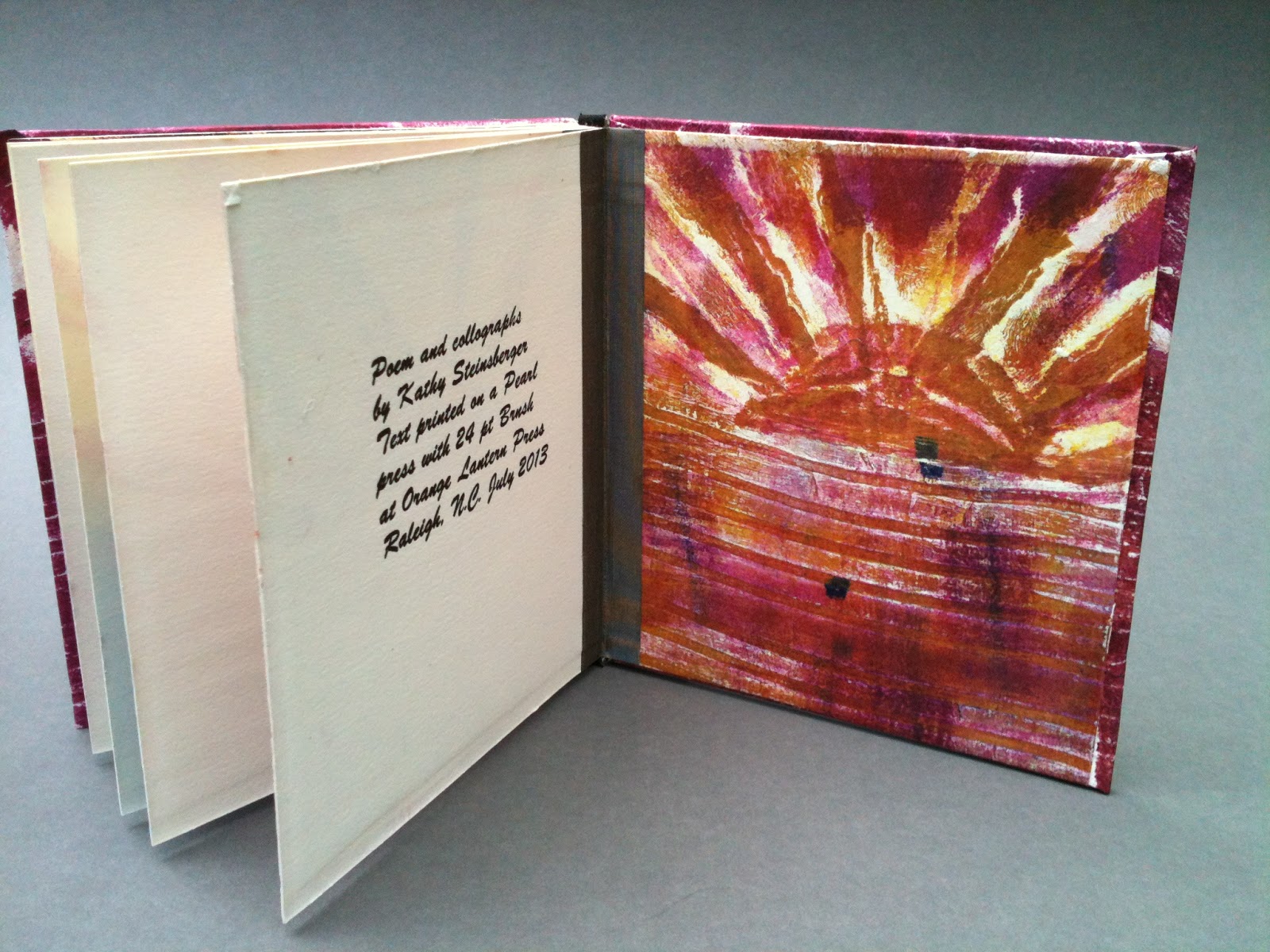
  This week's book is titled Horizon. Like all of the Book-A-Week books, Horizon is made as a stiff leaf book.  It's pages are of Stonehenge paper and it has hard book board covers with a book cloth spine piece of gray silk that matches the hinge material inside the book. The illustrations are collograph prints. The text was printed on a Golding® Pearl letterpress with 24-point Brush type.

   This is the press...it is a platen press.. meaning it has a flat plate to which the paper is attached which presses against the type to make the print. I call this press Pearl and I fell in love with her the first time I saw her a couple years ago. This press is probably about 100 years old and was manufactured by the Golding company of Boston, Massachusetts. You can read more about this press at: http://www.aapainfo.org/golding  My Pearl came to North Carolina from a letterpress shop near Ann Arbor, Michigan a couple years ago. I purchased her from a shop in the NC mountains and moved her to Raleigh last year. This week (Week 28!) was the first time I have printed on Pearl. Wow! What a sweetheart to work with.... everything worked just fine and I'm pretty excited!!!!
   Equally fun was making the illustrations. These prints were made on an etching press, not Pearl. (I haven't named my etching press.. wonder what would fit... rePete? Mark? Bruiser?) The illustrations are a series of collograph prints made from the same matrix (plate) of torn paper and a piece of pleated fabric glued onto a piece of bookboard to resemble a horizon. What a fun and exciting day that was experimenting with ink color! Using either a brayer or a squeegie (to get in the low spots) I applied several ink colors to the matrix... each time wiping the surface with a soft rag... thus leaving some colors in the nooks and crannies of the collograph plate and others on the higher spots and surface plane. This complex application produced lots of blending of the transparent oil-based inks, creating new and unexpected colors and hues.  Collograph printing creates a lovely layering effect which can be really surprising. For some of us printers, this process never produces two prints exactly alike.. just like life.

This is the poem, Horizon...


                                                             This horizon
                                                             It is an end
                                                            It is a beginning

                                                           It lies at the edge
                                                           of what is now
                                                           and what is yet to be


                                                           Silent as a broad sea
                                                           meeting the sky

                                                          A raucous mountain sunset
                                                          streaky with magenta,
                                                          orange, and red


                                                           This bridge
                                                           This curtain
                                                           This door
                                                           This line
                                                           This ridge


                                                           Two dimensions
                                                           Seen and not
                                                           This horizon
                                                           It is not an end
                                                           It is the point to transcend


   All books should include a colophon.. the biography of the book... which might include anything about the making of the book and sometimes includes the weather or the printer's frame of mind! In commercial books they are often found at the beginning of the book along with the copyright information. Sometimes they are printed at the end of the book. Horizon's colophon is on the last page of the book.. and is pretty circumspect for such an auspicious printing at Orange Lantern Press.

Finally, the back cover is another horizon... of a sunrise... or a sunset.. depending on how you look at it.