Sunday, May 25, 2014

Week 21: Baby Gate: Dreaming of Running the Bases

 This week's book Dreaming of Running the Bases is part of a tripartite boxed set of books titled Baby Gate.  Packages, bundles, presents... the book-of-the-week is about gifts... the sort of gifts that are natural and ordinary, and yet extraordinary in their power to produce change. An example of this is when a new baby is born into a family. With the passage of one day, all the lives connected with that birth are suddenly changed... and the whole family has gone through the Baby Gate. 

   The box that houses the set is an opposing-hinge box, which opens from two sides. It's covered by paper with everyday images like butterflies, postage stamps, and songbirds. The hinges are hand-dyed indigo bookcloth. Red satin ribbons are added to open and close the box lid. Inside, the box is covered with a collograph print of the sun shining through the treetops and vintage sheet music from a French songbook. Each of the three box sections holds one book. This week focuses on the middle section of the box... which houses a little accordion book with pop-out windows,  Dreaming of Running the Bases.
The box that holds the set...
Open the lid of the box from one direction.... and the center section is revealed with Dreaming of Running the Bases nested snugly inside.

a little book snug inside it's box
Pull the little book out, untie the baby blue satin ribbon, and peak inside. The cover is a recycled page from a children's book... a little boy in his baseball outfit, running the bases...

a baby blue ribbon holds the little book shut
and the back cover is a paste-paper painting of day-lilies and dragonflies.

paste-paper on the back cover
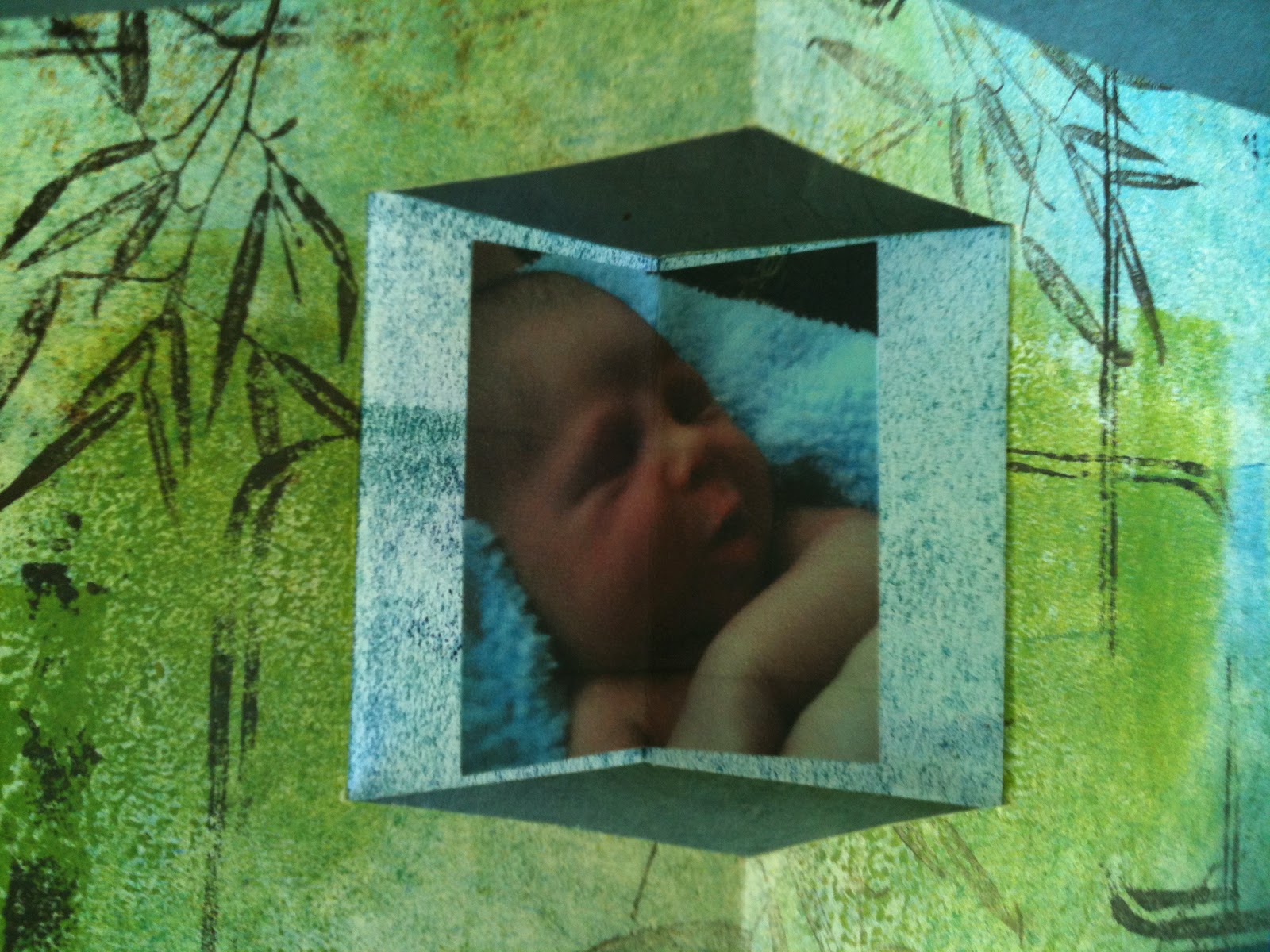
Unfold the little 4 by 4 inch accordion book to view an array of pop-out windows on the zigzag spine of greens, yellows, oranges, and blues. Created as a monoprint, the paper for the accordion is vibrant and energetic with the inference of new life and growth.


And inside... a photo journal of a one-week old baby sleeping... 

sleeping so sweetly...
dreaming....
dreaming of being at bat...
and getting a home run!!!
and dreaming... of joining the wide world...
nearby, a proud father cardinal in the garden...sings

Sunday, May 18, 2014

Week 20: In the Labyrinth


all closed up inside the box...
   The book-of-the-week for Week 20 is another book about labyrinths. This week's book, In the Labyrinth, focuses on the convoluted paths life can take...  It's constructed as an etui drop wall box with the the stories of four residences attached to the inner walls of the drop-wall box. When the lid is lifted, the 4 separate books that make the chapters can be seen glued to the inner side-walls.

looking from above...
One-by-one, or all at once, the walls fall flat and the chapter covers come into view. Each chapter has a photograph of the front porch of that residence glued to its cover... The front porch is the gate.

Chapter 3: An adventure! Holden Street, Pittsburgh
Chapter 1: 2324 Lyon Street & Chapter 4: 7909 Tulip Circle
When the four walls drop, all four chapter covers are visible...
4 places, 4 stories, 4 walls fallen down...
   Each chapter has the handwritten story on a folded paper structure called a boustrophedon... which means ox turning. .. Dating back to ancient Greece, boustrophedonic writing is lettering which moves across a line in one direction, then at the end of the line, reverses direction and moves in the opposite direction. At the end of each line, the direction of the writing is reversed. All the stories in In the Labyrinth read from left to right... it's the paper that is cut and then folded accordion style as a boustrophedon.


the Forum Inscription boustrophedonic writing in Latin, 5th-7th century BC
The folded-up boustrophedon opens like any other book, but as the pages are turned, there is a flipping that needs to occur so the book can continue being read. Just like life's little twists... and labyrinths...you never really know what's ahead.
inside each book... the story
These are the four chapters and the first few pages of each one...

(Chapter 1) 2324 Lyon Street
                 Raleigh, NC

It was the home of my birth.
It was the place I entered the world.
Mama, Daddy, my big brothers and I all fit fine in that 900 square feet.
It was all sunshine and roses and backyard Bar-B-Ques.

(Chapter 2) 72 Leah Drive 
                  Penland, NC

Imagine, living in Heaven.
On top of the world in a broad green pasture.
With the clouds so close you could touch them, breath them in...
Wrap them around you like a warm blanket.

(Chapter 3) 5808 Holden Street 
                   Pittsburgh, PA

It was a true adventure!
I was just tagging along, just biding my time for two years.
We made our way into this Shangri-La, bursting through the Fort Pitt Tunnel
to the vertex of three rivers and a spaghetti bowl of bridges and by-ways.

(Chapter 4) 7909 Tulip Circle 
               Raleigh, NC

It was my dream house.
A place to raise kids and re-live the good parts of the past.
The space inside was deceptive, SHAPE-CHANGING.
It was both warm and cosy, yet massive and rambling.

Boustrophedon fold-outs
open to the stories...
On the back of each boustrophedon is a GOOGLE map to the place that story is about...
the map folded out... and the story showing through from behind
When all four boustrophedons are unfolded, the maps are a jumble of folded paper... a maze of maps... a labyrinth of a life.
...map maze

Sunday, May 11, 2014

Week 19: The Gates Swing Open


   The book-of-the-week for Week 19 is a drop-sides box also known as an etui box.  The title of the book is The Gates Swing Open. A paper-cut gate is pasted to each of the four outer side walls. Under the gates, the bookboard side pieces are covered with vintage paper from an antique Japanese book about instructions to play the popular Japanese game GO. The lid is covered with black Japanese silk bookcloth, antique book paper, and a cube of laminated bookboard painted with black gesso. 


Inside the box the four side walls are lined with handmade Japanese paper which was letterpress printed with the lines of the poesy, The Gates Swing Open...

The Gates swing open
And the walls fall
DOWN

The Gates swing open
And the walls fall
DOWN

The Gates swing open
And the walls fall
DOWN

The Gates swing open
And the walls fall
DOWN


And they do! Lift the lid and the walls of the etui box fall down flat on the table. Inside the box is an old key... a material presence of the poesy words.

   The word poesy isn't used often these days.. George Gordon Noel Byron (Lord Byron), 1788–1824, used it in his poem The Prophecy of Dante...

"Many are poets but without the name,
For what is poesy but to create

From overfeeling good or ill; and aim
At an external life beyond our fate..."


It's definition states that poesy is 1) an archaic word for poetry, 2) the art of writing poetry, or 3) a poem or verse especially used as a motto. ...So isn't that what was done in this little 3-dimensional book, but create a motto to live by?

Sunday, May 4, 2014

Week 18: Labyrinth Poems

   Labyrinth is a word of Minoan origin, derived from the Lydian word labrys meaning double-edged axe. In modern-day English, a labyrinth is generally synonymous with a maze, but there is a distinction between the two in that maze refers to a complex branching puzzle with choices of path and direction; while a labyrinth has only a single, non-branching path which leads to the center and back. Labyrinths have been found all over the world and date back over 4000 years. Pliny the Elder’s (23AD-79AD) Natural History mentions four labrynths: the Cretan labyrinth at Knossos, an Egyptian labyrinth, a Lemnian labyrinth, and an Italian labyrinth. The symbolism of the labyrinth is wide and complicated, however, some of the oldest cultures have related labyrinths to royalty or to the beginning of creation.

   The most common labyrinth story is the Greek myth of Daedalus who built a labyrinth for King Minos of Crete at Knossos to house his half-bull half-man creature the Minotaur. When Daedalus fell in love with the king's daughter, Ariadne, King Minos put Daedalus in the labyrinth with the deadly Minotaur. The myth ends when Daedalus finds his way safely out of the labyrinth with a skein of thread given him by Ariadne.

   Since the Middle Ages, labyrinths have been associated with the Christian church.. resurrection, salvation, and enlightenment. The labyrinth in the medieval cathedral of Chartres in France is one of the most famous historical labyrinths still in its original form.
labyrinth at Chartres Cathedral, France
   This week's book-of-the-week is based on the labyrinth using Plato's idea of becoming lost in a variety of choices, where logic is in a delicate balance. If this post seems a bit rambling and confusing, that's because this writer became enamored with the MANY threads of information about labyrinths... and well... more than once... if not lost... well, off course... Inside a labyrinth it's impossible to see what's ahead.
pastepaper cover with a volvelle labyrinth
   Labyrinth Poems is a casebound book with silk bookcloth spine and pastepaper on the coverboards. It is also an interactive book. Spin the labyrinth volvelle on the front cover and pick out the words through the cut-outs to make a poem... Then, write the poem on one of the blank pages inside the book. The volvelle is based on the one-arm style of labyrinth, one of the simplest labyrinth forms. There are three rings that circle the center space. The outer ring of the labyrinth has words that are the articles A and The or pronouns. The middle ring has nouns or verbs, and the inner ring has verbs. 

standard one-arm labyrinth
words hidden behind the labyrinth walls, come in view through the cut-out windows as the wheel turns
The title on the cover and title page were printed with 12-point Roman typeface on the Pearl letterpress. Each page has a hand-carved linoleum block print with a labyrinth motif. The poems were written as they were generated with a Sharpie fine point pen.

title page
first poem... from words revealed on the volvelle
Plato used the labyrinth to describe the labyrinthine line of a logical argument in  his Euthydemus (384BCE)... 

"Then it seemed like falling into a labyrinth: we thought we were at the finish, but our way bent round and we found ourselves as it were back at the beginning, and just as far from that which we were seeking at first." 

Sunday, April 27, 2014

Week 17: Turnstile Pies

an old fashioned turnstile...
   Turnstiles are gates that move in a circle... gathering up a traveler in their embrace, carrying them around in a half-circle, then releasing them on the other side. There's something about turnstiles... that make them just a bit more intimate than the average gate. They may count your entry through a portal. They may have a mechanism for collecting tokens or payment  as you progress through an entryway. They always keep you in that place of transition... just a bit longer...than the average gate. 

   A place of transition is sometimes referred to as liminal space...  which is connected with thresholds and described this way. "In anthropology, liminality (from the Latin word lÄ«men, meaning "a threshold") is the quality of ambiguity or disorientation that occurs in the middle stage of rituals, when participants no longer hold their pre-ritual status but have not yet begun the transition to the status they will hold when the ritual is complete. During a ritual's liminal stage, participants "stand at the threshold" between their previous way of structuring their identity, time, or community, and a new way, which the ritual establishes." -Wikipedia

So why would someone want to stay longer in a state of transition? Perhaps... if pie is involved. The book-of-the-week for Week 17 is Turnstile Pies. It may be a stretch to make the connection between pies, turnstiles, and liminality... but there is no arguing that pies are a direct connection to the human psyche... Because they are just so delicious, they practically cause transcendence! And if pie isn't used for rituals... it SHOULD BE. When you are eating a delicious piece of pie, you feel like you have one foot on earth and one foot in heaven! Just imagine it as a big Turnstile Pie.

The front cover, with Cherry Peach pie in the window...
   Turnstile Pies is a ring-bound book covered with a 1940's vintage cotton tablecloth partially painted with acrylic paints. Affixed to the front cover is a paper volvelle painted to resemble a homemade pie and letterpress printed with the title, Turnstile Pies. Volvelles are paper wheel charts which date back to early medicinal and astronomy books of 11th century. They are fun, interactive elements of books.. and they resemble turnstiles because both rotate in a circle. Making a volvelle that connects with the term gate was a fun challenge for this week's book-of-the-week.

volvelle from Astronomicum Caesareum by Petrus Apianus, 1540
   The front wheel of the volvelle has been painted to look like the lattice crust of a pie. A small oval window has been cut out of the right side. The back wheel of the volvelle is the pie filling. It is separated into eight sections, each painted to represent a different flavor of pie. The name of each pie flavor has been letterpress printed on the back wheel so it can be seen through the window when spun to the correct position.  Cherry Peach Pie, Lemon Meringue Pie, Mincemeat Pie, Berry Berry Berry Pie, Pecan Pie, Pumpkin Pie, Chocolate Chiffon Pie, and Apple Pie are all eight of the (delicious) pies on the volvelle. 

Berry Berry Berry Pie...
Chocolate Chiffon pie...
Pumpkin pie...
Mincemeat pie...
Pecan pie...

The letterpress work for this book was a little challenging and especially fun. The placement of the type on the eight wheel sections involved eight separate printings. The placement of the printing with regards to the volvelle window, as well as the tabs... and the decision to match the font aesthetically with the flavor of pie, were all unique to this book. A colophon, listing all of the fonts used for the book in their exact typeface, was also printed for the book.
The colophon of typefaces 
 Turnstile Pies is an activity book with more to do than just spin the volvelle on the cover. Inside the book are six pages of recipes for pastries and pies, which can be followed to make delicious pies of all kinds. The recipes have been digitally reprinted from a vintage 1939 cookbook. They include, but are not limited to, the recipes for the eight pies listed on the coverpage volvelle. The recipe pages are separated by divider pages with tabs also printed on the letterpress. 
start with the crust...
Overall, the book  resembles the vintage 1939 cookbook it is based on.
The original source...and Grandmother's number one cookbook
A page of pie recipes... yum!
tabs in various typeface fonts... for easy retrieval..
The last section of the book is a section of ruled blank pages with the tab header More Recipes. This section is for adding new recipes and infers more interaction (and pies) in the future.

More recipes, yea!
handprinted ruled pages...
turnstile from a late 1800's cartoon... 
This French lady has gotten stuck in the turnstile.. did she eat too much pie?

Sunday, April 20, 2014

Week 16: Beyond the Garden Gate 2014


   The book-of-the-week this week is Beyond the Garden Gate 2014. This book is a map of a backyard garden. It's a hand-drawn sketch of the backyard plat here at Orange Lantern Press... made over nearly a month of planting from March 22, 2014 to April 17, 2014... and accompanied by snapshots of the garden plots taken on April 20, 2014. The title plate is a photograph of the garden gate leading to the backyard. The title was printed on the letterpress in Boul Mich. typeface. The snapshots are glued onto a piece of paste paper with a garden motif.
the cover with its title plate...
   The accordion-style book is bound by an ancient technique called a slat book or palm leaf book. Palm leaf manuscripts are found in Indian, Nepalese, and Southeast Asian culture and religions. The leaves of either the palmyra or talipot trees have most often been used for palm leaf books. The palmyra leaf, thick and inflexible, can become brittle, and most ancient texts are long gone. The thinner more flexible talipot has lasted as long as 600 years. 
ancient palm leaf book
   In Orissa, a state of India on the Bay of Bengal, palm leaf manuscripts are part of both historical and modern culture. The illustrations on palm leaf books are mainly of two types, simple engravings or illustrations in pure line on palm leaf and engraving with colour fillings. In these engravings, colours are muted and play a very minor part. Where colours are at all applied, they are just painted either to emphasize the inscriptions, or to fill up blank space. Today, the ancient art of palm leaf writing still survives. Religious texts continue to be read out from palm leaf manuscripts rather than from printed books. Horoscopes, too, are traditionally written on palm leaves by professional horoscope makers known as nahakas. The palm leaf was considered so sacred that even after printing presses began operating, important texts continued to be printed on the leaves instead of paper.
Palm leaf illustrations from Orissa, India
    Beyond the Garden Gate 2014 stands up on its stiff board slats like a folding screen. On the backside (or outside) are photographs of the actual garden taken this morning (April 20, 2014). Two green glass beads are threaded into the midpoint of two lengths of waxed linen thread that connect the slats. These beads also serve as the closure mechanism when the book is folded up and the loose ends of the waxed thread is wound around them.
all folded out...
   On the inside of the slat book is the map drawing of the garden. It is annotated with the dates of planting, dates of sprouting, and transplanting dates. Other items in the yard like the hammock, a large tree stump, and the sewer valve are also drawn on the map...and annotated to show their placement.
a map of the garden
   Annotated texts are interwoven with the primary source text in order to make a book more reader-friendly or to include pertinent notes for a study guide. The goal of an annotated text is to facilitate reading and comprehension of the source media. Some famously annotated books include: Sylvia Plath's copy of The Great Gatsby, Mark Twain’s annotations to the title page of Plutarch’s Lives of Illustrious Men, and Vladimir Nabokov’s copy of Kafka’s The Metamorphosis. (http://flavorwire.com/394100/classic-books-annotated-by-famous-authors/view-all) Whether you are pro altered-books genre, or anti-... annotations are another layer in a narrative... a sort of whisper of the personal story of the reader... a behind-the-scenes subplot. 


However, other than the cats (Charlemagne and Louis) lurking around... there isn't much intrigue in this week's book. The sunny photos of the budding new plants in their newly turned weed-free soil beds and snug under their golden straw blankets... are all about a cheerful, upbeat, flourishing... Spring! 
garden gate photos... an Easter Basket of colors!
A closer look of the photos on the book...
pea bed by the fireplace and herb garden on the brick path
kitty cats, parsley and garden pots...

A closer look at the drawings on the map...
peas, onions, herbs, peppers...seedlings
pole beans, kale, tomatoes,  beets...
There's always some place of inspiration.. some seed...


Garden gate in France, 2008
and all there is Beyond the Garden Gate...
garden in France