Sunday, December 15, 2013

Week 50: The Library

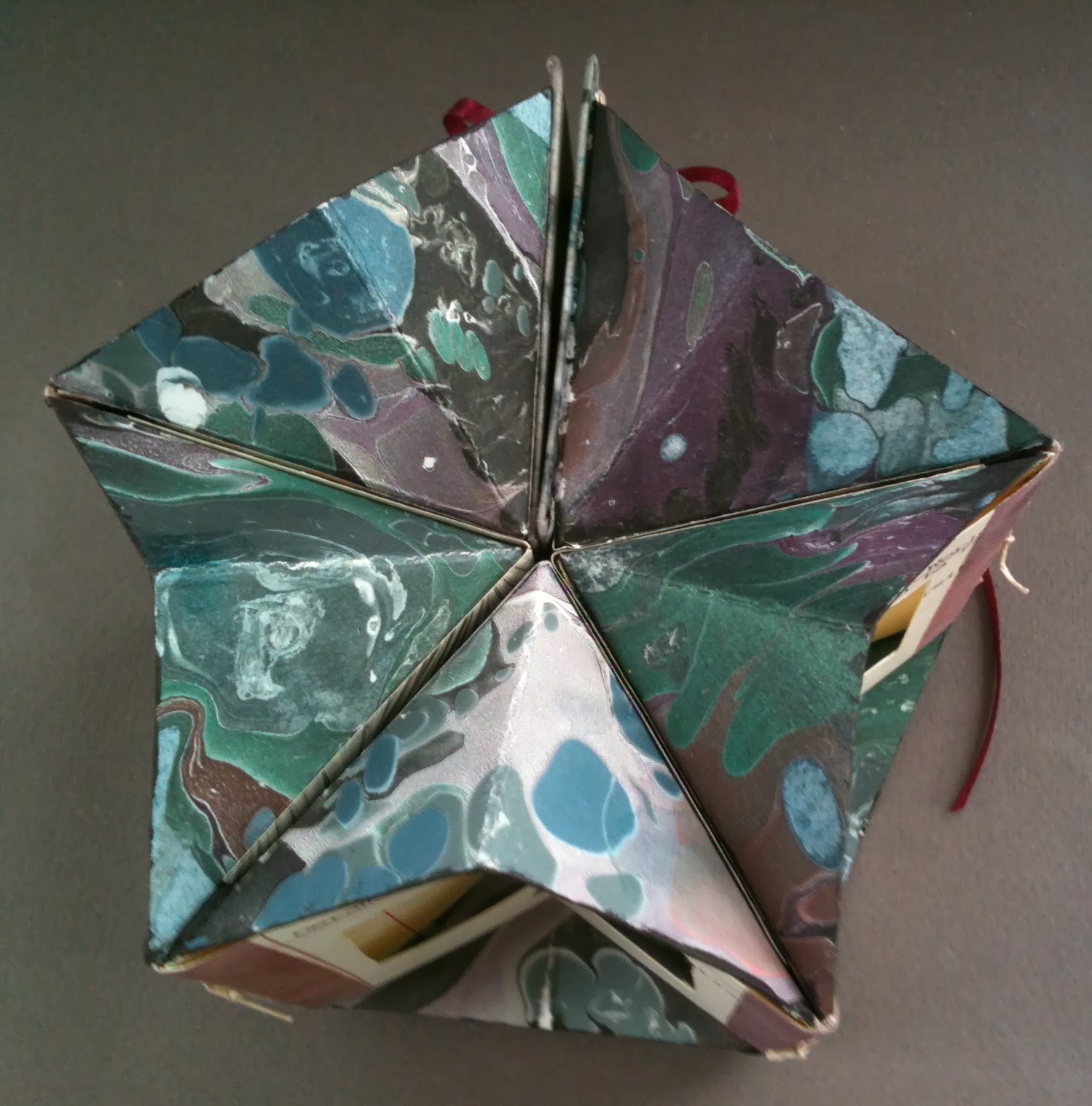
   The book-of-the-week for week 50 is titled The Library. It's a small carousel book with 5 page sections made of old card catalog cards, pages from an 1850's Harper's Monthly, pastepaper, marbled paper, a bit of glue, and ribbon...
carved stone wall of a library in Rome...
   The first libraries originated in Sumer (present-day Iraq) in 2600 BC to house the oldest books... the Sumerians' clay tablets of cuneiform script. In the 6th century BC, the great Mediteranian libraries of Alexandria (Egypt) and Constantinople (Byzantine Empire) were considered the greatest libraries in the world and housed hundreds of thousands of papyrus scrolls. Though the library at Alexandria was burned by the Romans in 48BC and the library at Constantinople was destroyed by a number of fires and wars from 474 AD until 1204... still, beautiful and significant libraries continue to populate our world in every culture and country. Some libraries are specialized collections of rare books, letters, papers, and antiquities housed in museums, churches, temples, and universities. Others are composed of modern information systems of digital media and complex robotics which are located in research centers, government complexes, and modern-day think tanks. ...And some libraries are regional public libraries... old and new... that serve a variety of book devotees in their everyday life. The Library  is inspired by one extraordinary public library... the Carnegie Public Library in Pittsburgh, Pennsylvania.

Carnegie Public Library,  1905
"On April 26, 1898, Mr. Carnegie approved a grant of $200,000(by the end of the project, this figure had increased to $244,000) to purchase property and construct a building to house a Free Public Library, 800-seat Music Hall, Lecture Hall(now with 140 seats from the former Grand Theater of Carnegie, Pennsylvania), and Gymnasium. This amount included funds for purchasing enough land, not only for the building, but also for a small in-town park adjacent to the building. This grant also included an additional $10,000 for the purchase of the Library's first supply of books. After the purchase of property, construction of the building, and the purchase of the first supply of books, the remainder of the $254,000($93,000) was used to establish an Endowment fund for the Andrew Carnegie Free Library. The site chosen for this project was on a hill in the middle of town, overlooking the business district." 
- History of the Andrew Carnegie Free Library and Music Hall Carnegie, Pennsylvania, By Glenn A. Walsh, September, 1997; June, 2000

The old libraries have that warm cozy aura of polished wood, tall ceilings, and stacks and stacks of bookshelves... The five page sections of The Library are glued side-to-side to form a series of three accordion strips which are then sewn together with pamphlet stitches.  At the top and bottom of each page section, there are tipped-on folded triangles that create the floor and roof. 

stretched out like book cases...
This is a great exercise in geometry.. figuring out the angles of the triangles so the floor lies flat and the roof  slants upward when the book is pulled back to form the carousel. Just in case you want to try it, the triangles of a 5-piece carousel book that lie flat are 72 degrees at the vertex angle and the triangles that are slanted upward are 90 degrees (or more) at the vertex angle. 
the carousel...with marbled paper floor and roof and tied with a red ribbon

Each page section has three layers of paper. The back layer is solid, but the two front layers have cut-outs which create a tunnel-like effect with see-through windows.
see-through windows
...and the architecture of the Pittsburgh Carnegie Public Library has the same layering effect.
inside the Carnegie Public Library, Pittsburgh
The Library unfolds and transforms... as all libraries do....


the roof like aged copper...  or a star shining in the sky

Sunday, December 8, 2013

Week 49: The Peace Temple

  For people who love books, reading a really intriguing story can be like moving into the book.  The book becomes a sort of shelter... a house... a temple. This week's book-of-the-week, The Peace Temple, is based on that feeling... of living inside the book.
bamboo, paper, copper and string make the The Peace Temple
The Peace Temple is based on the Japanese Tanabata festival (Festival of Wishes), which is celebrated each year on July 7th, or August 8th. Mentioned in an earlier post (http://paperbuttons.blogspot.com/2013/06/week-25-court-of-heavenly-empress.html), on this day people write their wishes on strips of paper and hang them from trees and bushes outside their home, or on doorways, gates, and thresholds nearby. The paper strips make a beautiful cacophony of planer surfaces and text. .. a presence in the world and hope for a better one... 

The words on over 650 strips of handmade paper
A handwritten banner with the word...PEACE hangs from the central ridge pole of The Peace Temple. What better wish to make in a house of wishes? The Greeks and Romans built temples for their favorite gods and goddesses... places to meditate, bring offerings, study and keep the stories of the gods, carry out rituals, and pray.  So The Peace Temple was conceived and built as a modern-day temple for the gods and goddess of peace. In ancient mythology, Eirene was the Greek goddess of peace and Pax was her Roman counterpart.... Baldr was the Norse god of peace... and Vishnu, the god of peace for the Hindu religion. In our time, several individuals stand out as gods or goddesses of peace. On this week, especially, we are grateful for the life yet saddened by the passing of Mr. Nelson Mandela (July 18, 1918-December 5, 2013)
the center Peace banner... three feet long and made of handmade paper 
   So how was The Peace Temple constructed? The 10-foot tall bamboo structure fits together like a room-size Tinker Toy®. Right-angle bamboo ladders form the corner pieces, which are connected with bamboo poles laid on top and held in place with wooden pegs. The pyramidal roof is made of eight bamboo poles slipped onto wooden dowels protruding out of a wooded hub.. with a matching copper roof affixed to it's tip.
TinkerToy®
The roof poles snap onto the hub pegs... like Tinker Toys!
With very little effort, The Peace Temple snaps into place.

Raising the roof!
The pages of The Peace Temple are over 650 strips of paper that are tied to the rungs of the ladder-walls and the roof poles with string. The strips have been letterpress printed with BRUSH- or CASLON- font antique movable type... and say either I WISH or PEACE. The I WISH  printed paper strips are made of a very thin Japanese handmade paper that is tipped on the string-end with a variety of paste painted or marbled papers. This bit of color in the otherwise white structure, is reference to the spiritual and revered illuminated manuscripts of the Middle Ages... as well as the beautiful complexity of humanity. The PEACE printed strips are of Italian mould-made paper that is smooth and creamy.

hanging the strips to the wall rungs...
a meditation in tying the I WISH and PEACE pages...
   Now completed, the book stands in the Code X show at the Carrack Modern Art gallery in Durham, NC for another week. It is meant as an interactive book. People can walk inside The Peace Temple, move the pages with their hands, meditate, pray, or play. On Friday evening, December 13, 2013, The Peace Temple will be  part of an interactive music performance with musician Graham Cox. If you are in the area, you are invited to join the event from 6-9pm at 11 W. Parrish St. Durham, North Carolina.
The artist inside The Peace Temple
   The Peace Temple is an exercise in creating a book which is capable of acting as a book as well as a place to exist. The Penland School of Crafts http://penland.org will offer a class titled Living Inside the Book in the summer of 2014. This class will be taught by book artist Kathy Steinsberger and professor of architecture, Sara Glee Queen. Part of the course description reads... This course will expose the shared qualities of books and architecture in order to investigate the role that book structure and form can play in defining the “rooms” or spatial moments of a narrative.
a lighted tunnel with it's own story...

Peace

Sunday, December 1, 2013

Week 48: Dream

    The book-of-the-week is Dream. ...the only word in the book.
 pastepaper cover over boards and silk bookcloth spine
dreaming....
dreaming...
...awaking.
"Hope is a waking dream." - Aristotle

Sunday, November 24, 2013

Week 47: The Topiary Ballet

Two parts of The Topiary Ballet
    The book-of-the-week, Topiary Ballet, consists of two parts... a stiff leaf book and a tunnel book. It is a brief story about some dancing shrubbery. Most of the time, a book is the information contained wholly on the pages bound between the two covers. But sometimes, a book has elements that are separate. They may be a selection of letters and postcards nested within (and removable from) page envelopes... such as Nick Bantock's Griffin and Sabine Trilogy www.nickbantock.com. Or, they may consist of a variety of pamphlets, newspapers, broadsides, and clothbound books stashed inside a book-shaped box... like Chris Ware's NYTimes 2012 Notable book, Building Stories. Another fantastic example is Personal Paradigms: A Game of Human Experience by book artist Julie Chen of Flying Fish Press.
http://www.flyingfishpress.com/booksinprint/personalparadigms.html. Just knowing that there are so many options in creating book content opens up the imagination to unlimited ways of telling a story and making a book!

The cased-in tunnel book and it's stiff leaf book partner
   Pastepaper covers are the first hint of what's inside The Topiary Ballet.  Lively red flowers seem to burst off the paper... and a net-like grid alludes to both ephemeral alchemy and structured floriculture. Shades of green, gray, and terra cotta refer to nature and the earth elements. ...And the sizes are meant to fit comfortably within the hand or on a tabletop. The tunnel book is about 7 inches tall and 8 inches wide. The little stiff leaf book that accompanies it is about 5 inches tall by 4 inches wide and has a letterpress title-plate inset atop it's pastepaper cover. 

real and imagined

pastepaper art on the cover...
   Open the tunnel book cover and 5 panels depict the stately topiaries in a sun-lit glow. When creating tunnel books, it helps to have an idea of the rules of perspective. It's also useful to remember that things in the back need to be seen, so don't cover them totally with images in the forward panels... Cutting out sections of the panels so one can see through is a necessity. There are many on-line resources for how to make tunnel books. Examples of many fascinating tunnel books can be seen on Carol Barton's webpage,

The topiaries... tall and stately (during the day)
   The little letterpress stiff leaf book of the dancing topiaries has a hard cover and silk bookcloth spine pieces which bind the pages. The pages of the stiff leaf book and the tunnel book accordion side pieces are made of Pop-Tone cover weight French Paper  (www.frenchpaper.com) in the lemon drop shade. The panels of the tunnel book are cover weight Stonehenge paper which was painted with acrylic paints. This is the story...


The Topiary Ballet

There stands in formation

In the land of Pin

eight silent and stately

tall green men.
    -------------------                   
They stand in two rows

that lead to the gate

and the moat and chapel

of the great estate.
     --------------------                            
Over the frogs in the lily ponds

they keep a watchful eye

for pesky lads and treacherous hawks

swooping from the sky.
       ---------------------                                    
Like chessmen they stand there

along the terrace to the Keep.

But come nighttime they get up and

dance while we sleep!
      ----------------------                             
They shake their long limbs,

do some boogie-woogie voodoo!

They sway in the moonlight

and sing Abba’s “Voulez Vous...”
          ------------------------                                   
If you asked them they’d tell you

the monotony of their days...

but their nights are a curiosity

of arboreal ballets!


The collophon: printing information
   The inspiration for the book is seen in the black and white photo attached to the back of the tunnel book. The real topiaries were planted sometime after the year 1920 by a young husband along the entryway to his wife's and his new home... a 300-year old chateau in the Loire Valley of France. The topiaries have been maintained for many years by one of his granddaughters and her staff at Chateau du Pin, Champtoce-sur-Loire, France ( http://sci-le-pin.com). As far as this visitor knows, the topiaries do not dance nor sing at night, but magic is definitely happening in this lovely place.

through the topiaries, past the chapel, through the gate, over the moat, 
to the 700-year-old chestnut grove

Sunday, November 17, 2013

Week 46: 29 Dresses

The Hwy 311 Flea Market near Sofia, NC
   The book-of-the-week for this week, 29 Dresses, is about a collection. Some days the bustle and hubbub of life seem to rise in a crescendo through objects... Whether it's chinaware, furniture, a certain child's toy, or a rack of sequined ball gowns... each has its own story.. signifying a sort of chapter in the book of a person's life. Recently, an outing to the Highway 311 Flea Market in rural North Carolina illustrated that same energy and narrative. While walking through a labrynth of clothing, chinaware, furniture, toys, military memorabilia, old tools, and more... the fullness of life was oddly displayed in the discarded remnants and the cheap merchandise. 
The cover
    The cased-in cover of 29 Dresses has hand-dyed indigo bookcloth and marbled cover paper. The title plate is letterpress printed with Antique Caslon typeface and indigo blue ink. Looking down on the book, the 29 dresses, glued onto the stiff pages, give the book a slightly rumpled, textured effect. One by one, the dresses tell a story...

the glued-on dresses and indigo bookcloth spine pieces.
Dresses of a child's book and a pastepaper painting
Dresses of a Paris map and gardening seed catalogue
Dresses of notebook paper and Japanese cloud paper
Dresses of a magazine page and a monoprint in pink
Dresses of a collograph print and a peacock feathers print
Each of the dresses in 29 Dresses has it's own story... just like the racks of clothes and the tables of goods at the Highway 311 Flea Market.
Inside the labyrinth of things
To make paper folded dresses, check out the You-tube video www.youtube.com/watch?v=yp3Aehoo-w.

Sunday, November 10, 2013

Week 45: The Reminder of Christmas Past


   The book-of-the-week for Week 45 is The Reminder of Christmas Past. This little stiff leaf book is a three dimensional assembly of stiff paper triangles that have been folded in half then glued on their adjoining outer sides. Depending on the scale, this book structure can fill several useful guises, from holiday tree ornament... to door stop. 


This particular book accompanies the ongoing House series.


The poem, The Reminder of Christmas Past is handwritten inside with sepia toned calligraphy ink and an old fashioned pen and nib...


The Reminder of Christmas Past

It stands in the yard
somewhat alone -
The small fir tree
A relic from some long ago
Christmas.
Bought with the fervor,
the impending
importance

of the yearly
drama played out
as Love, Devotion, Joy and Peace
One night a year.
So it stands, somewhat alone -
in the yard. Because
trees should not
be grown, harvested,
sold,

used for
one night a year
and discarded! No!
So it was harvested with its roots
intact, and after the celebration, was
planted in the corner of the yard...
an odd reminder of Joy and
Devotion, Love and
Peace.


Not just a singular book about a place in time, this little tree is part of the setting... it moves around the books of the House series as some toy soldier on movements. It stands sentry by the tree house stairs, or perches on the porch veranda.


When all the doors of the old house and the tree house and garden shed are flung open, it stands firmly in the center of the stage.


...and in the corner of the yard at Orange Lantern Press, the real little tree stands guard at the beginning of the driveway.

Saturday, November 2, 2013

Week 44: Ode to Stairs

   The book-of-the-week for week 44 is titled Ode to Stairs. It is an additional book to the House series. Ode to Stairs completes the Garden Shed and The Tree House book set...maybe.

The front cover of the book has a cut-out silhouette of a staircase over pastepaper and sepia toned sun-printed kozo. It was planned to resemble the real stairs leading to the tree house and garden shed in my own backyard.


The soft spine cased-in book opens to a single folio which is letterpress printed with the title, Ode to Stairs. The folio has been affixed to the case so it's centerfold is at the base of the book rather than along the spine. 


That way, when the page is pulled down, the stairs rise up as if they are leading up to the tree house. The stairs are a type of box pop-up known as origamic architecture. Read about architectural origami at http://en.wikipedia.org/wiki/Origamic_architecture. 


   The poem was letterpress printed along the side of the pop-up. Hand-marbled paper was used for the background and a grey-tinted white ink used for the letterpress printing. The font is 12-point Caslon.


Climbing up stairs takes some effort, but once at the top, there is always a feeling of having accomplished something. Is there the same feeling when descending?