Sunday, April 20, 2014

Week 16: Beyond the Garden Gate 2014


   The book-of-the-week this week is Beyond the Garden Gate 2014. This book is a map of a backyard garden. It's a hand-drawn sketch of the backyard plat here at Orange Lantern Press... made over nearly a month of planting from March 22, 2014 to April 17, 2014... and accompanied by snapshots of the garden plots taken on April 20, 2014. The title plate is a photograph of the garden gate leading to the backyard. The title was printed on the letterpress in Boul Mich. typeface. The snapshots are glued onto a piece of paste paper with a garden motif.
the cover with its title plate...
   The accordion-style book is bound by an ancient technique called a slat book or palm leaf book. Palm leaf manuscripts are found in Indian, Nepalese, and Southeast Asian culture and religions. The leaves of either the palmyra or talipot trees have most often been used for palm leaf books. The palmyra leaf, thick and inflexible, can become brittle, and most ancient texts are long gone. The thinner more flexible talipot has lasted as long as 600 years. 
ancient palm leaf book
   In Orissa, a state of India on the Bay of Bengal, palm leaf manuscripts are part of both historical and modern culture. The illustrations on palm leaf books are mainly of two types, simple engravings or illustrations in pure line on palm leaf and engraving with colour fillings. In these engravings, colours are muted and play a very minor part. Where colours are at all applied, they are just painted either to emphasize the inscriptions, or to fill up blank space. Today, the ancient art of palm leaf writing still survives. Religious texts continue to be read out from palm leaf manuscripts rather than from printed books. Horoscopes, too, are traditionally written on palm leaves by professional horoscope makers known as nahakas. The palm leaf was considered so sacred that even after printing presses began operating, important texts continued to be printed on the leaves instead of paper.
Palm leaf illustrations from Orissa, India
    Beyond the Garden Gate 2014 stands up on its stiff board slats like a folding screen. On the backside (or outside) are photographs of the actual garden taken this morning (April 20, 2014). Two green glass beads are threaded into the midpoint of two lengths of waxed linen thread that connect the slats. These beads also serve as the closure mechanism when the book is folded up and the loose ends of the waxed thread is wound around them.
all folded out...
   On the inside of the slat book is the map drawing of the garden. It is annotated with the dates of planting, dates of sprouting, and transplanting dates. Other items in the yard like the hammock, a large tree stump, and the sewer valve are also drawn on the map...and annotated to show their placement.
a map of the garden
   Annotated texts are interwoven with the primary source text in order to make a book more reader-friendly or to include pertinent notes for a study guide. The goal of an annotated text is to facilitate reading and comprehension of the source media. Some famously annotated books include: Sylvia Plath's copy of The Great Gatsby, Mark Twain’s annotations to the title page of Plutarch’s Lives of Illustrious Men, and Vladimir Nabokov’s copy of Kafka’s The Metamorphosis. (http://flavorwire.com/394100/classic-books-annotated-by-famous-authors/view-all) Whether you are pro altered-books genre, or anti-... annotations are another layer in a narrative... a sort of whisper of the personal story of the reader... a behind-the-scenes subplot. 


However, other than the cats (Charlemagne and Louis) lurking around... there isn't much intrigue in this week's book. The sunny photos of the budding new plants in their newly turned weed-free soil beds and snug under their golden straw blankets... are all about a cheerful, upbeat, flourishing... Spring! 
garden gate photos... an Easter Basket of colors!
A closer look of the photos on the book...
pea bed by the fireplace and herb garden on the brick path
kitty cats, parsley and garden pots...

A closer look at the drawings on the map...
peas, onions, herbs, peppers...seedlings
pole beans, kale, tomatoes,  beets...
There's always some place of inspiration.. some seed...


Garden gate in France, 2008
and all there is Beyond the Garden Gate...
garden in France

Sunday, April 13, 2014

Week 15: The Complexion of a Landscape

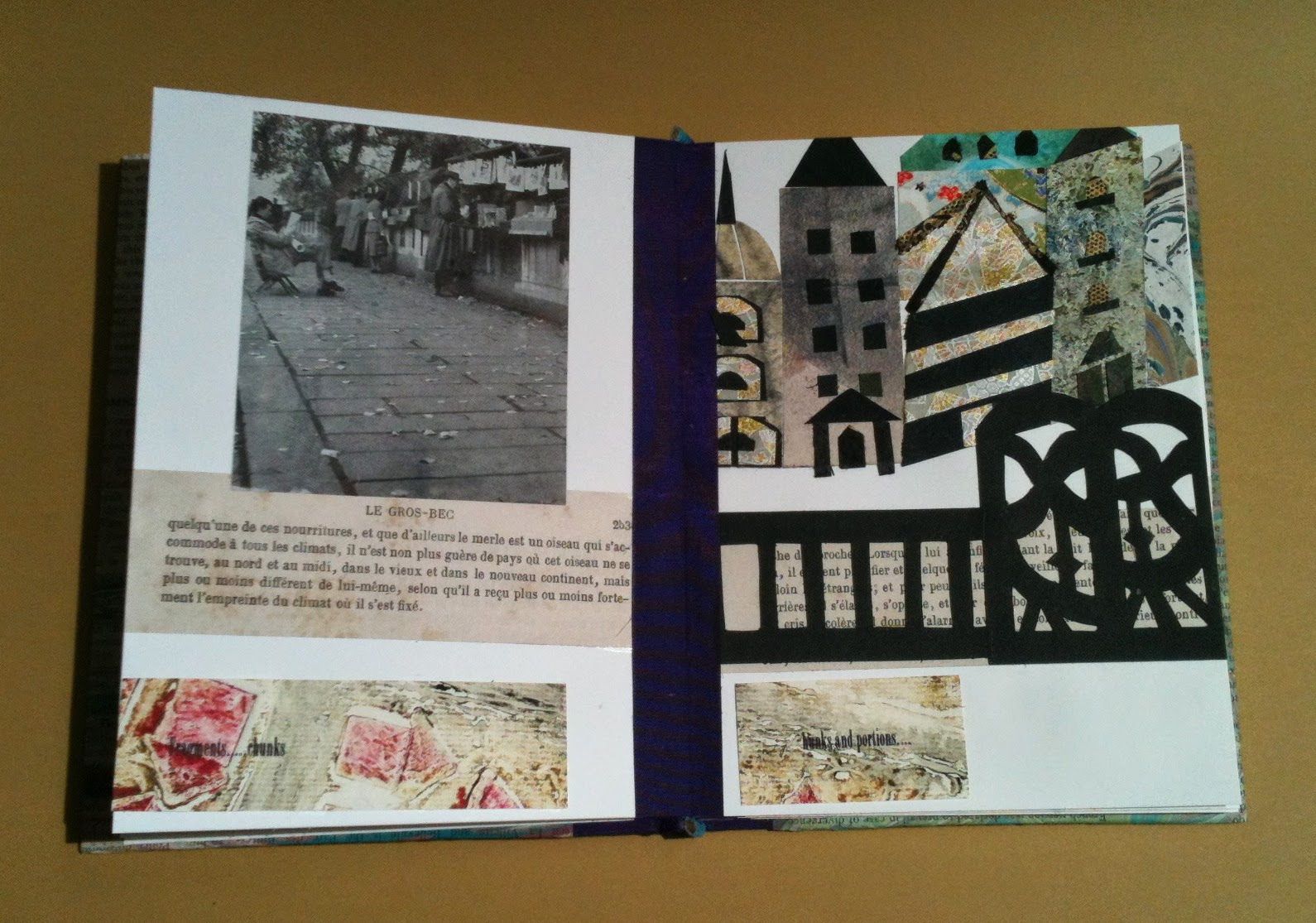
The book-of-the-week for Week 15 is The Complexion of a Landscape... an assembly of various papers painted on the page to create landscapes through collage. The simple poem, a list of synonyms for the word pieces, alludes to the diversity of a place. 
Cased-in cover of marbled antique book pages, silk bookcloth, collograph print
   The book includes strips of pages from an antique reference book on animals (Histoire Naturelle de Buffon de Lacepede, 1879, Tours, France), photographs from a 1956 Tour Guide of Paris, and a variety of cut-outs from pastepapers, marbled papers, collograph prints, and assorted commercial paper scraps from bins at the Orange Lantern Press studio. 

 Endpaper and Title page...

Scraps... segments...   
                                                      
slices and allotments....


Fragments.....chunks      
                                                   
hunks and portions....


(more) hunks and chunks... 
                                                        
bits and cuts... divisions


fractions and fractals....

morsels and moities   


pieces....parts...partitions...


A kaleidoscope of shape and color
in the complexion of a landscape, 
the diagram of place.

Sunday, April 6, 2014

Week 14: Indigo Chaos

     The Merriam-Webster dictionary defines chaos as  1) complete confusion and disorder: a state in which behavior and events are not controlled by anything; or 2) the state of the universe before there was any order and before stars and planets were formed. 
Creation theories aside, life isn't always characterized as chaos... but in this week's book-of-the-week, Indigo Chaos, it is. 


   Indigo Chaos gets it's title from the background imagery created by drawing with a string and india ink on a polyester plate; then using lithography to print the image in shades of blue on sheets of text paper. The random marks bring to mind a jumble of disorderliness, as if one were tumbling in an abyss of the unknown. Instead of using a codex-style book form, the pages have been assembled into an accordion book. Which, with it's zig-zag structure, reiterates the concept of non-conformity. The page connections are facilitated with black Yuzen (printed Japanese) paper, chosen to remind one of an iron gate...life being the ultimate gate. And the gate also symbolizes transition... which is often associated with a feeling of chaos... or lack of control. Red silk thread runs through the entire book... again, signifying life. Geometry personified, it juts up and down, makes crosses and loops, and seems to speak it's own language. 


Finally, there is the poem...written by this artist (while digging a garden bed for summer squash... note the reference to rocks and weeds...and the wilderness!) and then letterpress printed on Pearl (the 100-year old press here at Orange Lantern Press) as a variable edition of three. This is the poem...


INDIGO CHAOS


Sometimes life
feels like an Indigo Chaos

and you just have 
to find your way
                        out

through the blood gates
of memory  

You will find
your way


Following that thin
red line...         

one day
to the next 


and even when
you’re through (the gat)e...

you’re not through, 
really.


Find a good spot,
squat in the dirt

and pick out the 
rocks.


Don’t think you can
pull out all the weeds     

They’ll just grow back 
stronger 

...and you will too.

When life swallows you 
whole    
and you’re in the wilderness. 

                                          -kcs


The last page.. the Colophon... a short list of the attributes or bio of the little book. And see.. the red thread has gone WILD!

Sunday, March 30, 2014

Week 13: Less is More

   A quote can be a gate to a personal philosophy, a mantra for a cause, or that endless ad jingle rattling in your ear. In this case, the quote "less is more" ... originally from the 1851 poem Andrea Del Sarto (or The Faultless Painter) by Robert Browning (http://www.bartleby.com/42/675.html)... was used by pioneer modernist architect, Ludwig Mies van der Rohe to define his architectural style. The original poem by Browning has nothing to do with the sleek lines and circumspect visage of Mies van der Rohe's pure forms and spacious interiors... in fact, the quote doesn't appear until lines 70 through 78 of the poem! and has nothing to do with space and form, but rather, a somewhat lovelorn drama and extensive self inspection.. as Browning's works can be... where each line seems to hold the information of a hundred trains of thought...

"I could count twenty such
On twice your fingers, and not leave this town,
Who strive—you don’t know how the others strive
To paint a little thing like that you smeared
Carelessly passing with your robes afloat,—        75
Yet do much less, so much less, Someone says,
(I know his name, no matter)—so much less!
Well, less is more, Lucrezia: I am judged." -R. Browning

Oh well, the book...

"...I am judged." -RB
The Colophon:
Less is More is a tiny 2-inch by 2-inch case-bound book constructed of black silk bookcloth, hand-painted pastepaper, and gray Rives BFK paper. Binding is completed with the kettle stitch with french-link binding. The fore-edge of each page is tipped with black bookcloth to resemble posts of a wrought-iron gate. A strand of metallic silver thread is strung through each page as well... similar to the industrial steel cable outlining Mies van der Rohe's balconies and stairwells. 


silver thread along the fore-edge..
Each page was illustrated by this artist with calligraphic brush marks in India ink.

mark of entry
Polyester plate lithography was used to transcribe the single line of text, in InaiMathi 18 pt. font, of Mies van der Rohe's adaption of the Browning quote "Less is More".
... a cross can mean change...
more of less...
symbolism of three
...the gate
Fifteen pages of the quote, "Less is More," with fifteen unique pen and ink drawings complete the tiny book. Unlike many of the works of Mies van der Rohe, it is physically insignificant.

Some examples of the works of Ludwig Mies van der Rohe...
architectural drawing of an unfinished 1950's residential complex
Seagrams Tower, NYC
Barcelona chair
Farnsworth House


simplicity
a gate
and permission 
becomes 
your shelter
            -kcs

Sunday, March 23, 2014

Week 12: Growing Up: Vintage Trading Cards Set

   What do gates have to do with growing up? Between the blown-out birthday candles of a lifetime and the countless days in between are many gates... Most often, the gates are invisible. They are the metaphysical gates of change happening.  A new year doesn't cause the transformation, living does. The book-of-the-week for Week 12, Growing Up: Vintage Trading Cards Set  is a book about some of these gates. It's a snapshot of a period in time for a little boy during his first few years... Some are real memories and some are fun-loving fiction... Instead of a traditional photo book or childhood journal they are expressed as athletic trading cards. 

a tape measurer and magnet create the clasp
   The book structure is an accordion book with pockets... and can be a sort of activity book...with trading cards going in and out of the pockets. The accordion pages are heavyweight Mohawk paper, mono-printed in shades of green and blue. Inside each pocket fits a Growing Up Trading Card. The front of each card is a polyester plate lithograph (of a photograph) of the little boy. On the back side is a fictionalized account of the lithograph's event in the style of a real athletic trading card.

Here, the trading cards are inside the pockets

Here, the trading cards are pulled out of the pockets

Track and Field trading card... Gold Medalist?

the title card...

the title card, photo side

the title card print side... and the Track & Field card
Trike #34, Nascar Hall of Fame
card for Trike #34, Nascar Hall of Fame
Greatest Clown
silly boy did all those things!

Top Gun World Traveler...
Shredding the gnar on the pow
Robo-Guy: can do anything!
all the things Robo-guy can do when all grown up!
   Baseball trading cards date back to the 1860's when they were printed by sporting goods companies. By the early 1900's they were placed inside candy and tobacco products as a free gift. In 1909 the American Tobacco Company released the T206 tobacco card set in their cigarette packages. This set included the T206 Honus Wagner card... which is said to be the rarest baseball trading card of all time. In the 1950's the Tops Chewing Gum Company began inserting trading cards in its packs of gum and began including the sports players' game statistics. In addition to sports figures, the Tops cards included TV and movie stars, astronauts, and other celebrities. Non-sports cards produced by Topps included Wacky Packages, Star Wars, and Garbage Pail Kids.  By the 1980's  Topps was the leader in the trading card industry. When trading cards began, they were added incentives to buy gum, candy or cigarettes... by the 1990's, the cards were valuable on their own and the cards were sold without the gum.

the all-time favorite baseball card of the little boy in the book...